
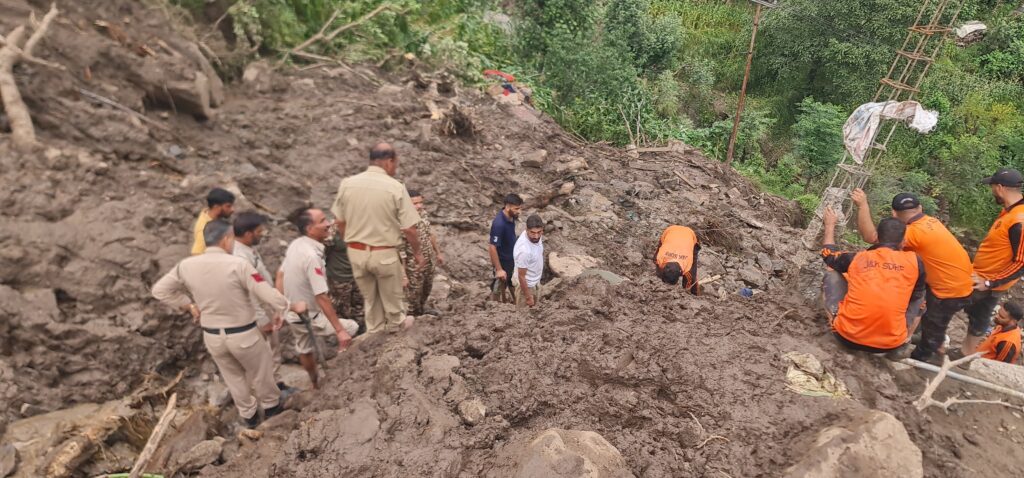
KULGAM, AUGUST 7: Kashmir is in the middle of one of its most cloudburst-hit summers in recent memory. According to officials, Jammu and Kashmir has recorded at least 44 cloudburst or flash flood events between July 1 and August 5, leaving around 31 people dead and causing widespread damage to homes, roads, bridges, agricultural land and other public infrastructure.
“From July 1 to August 5, Jammu and Kashmir has witnessed at least 44 cloudburst or flash flood events,” Dr Mukhtar Ahmad, Director of the Meteorological Centre, Srinagar, told Kashmir Upfront.
He attributed the heightened frequency of these extreme weather events to active monsoon currents from the Arabian Sea and the Bay of Bengal, coupled with weak Western Disturbances (WDs), which have created favourable conditions for intense rainfall across the region.
The past week alone has witnessed a string of incidents across both divisions of the Union Territory. On August 1, a massive cloudburst struck the Chatroo area of Kishtwar district, with floodwaters carrying debris, uprooted trees and rocks into residential areas and a local market, causing cracks in several houses and washing away parked vehicles. The same day, heavy rainfall triggered flooding and flash floods in parts of Jammu and Kashmir, inundating residential areas in Shopian district and causing extensive damage in Kishtwar, prompting authorities to shut schools across the Chenab Valley.
Days later, a woman died after a cloudburst triggered flash floods in north Kashmir’s Kupwara district. The deceased, a resident of Warnow, was swept away by a sudden surge of water in the Himli area of Lolab. On Monday, two people were killed after multiple cloudbursts and intense rainfall battered several parts of Jammu and Kashmir and Ladakh, triggering flash floods and forcing the closure of the Jammu-Srinagar National Highway. That spell of extreme weather affected Kupwara, Shopian, Bandipora and Anantnag. By Wednesday, a fresh cloudburst was reported in the Nagam area of Kulgam district, sending water levels surging in the Namlan Nallah and several other streams, even as the Meteorological Centre, Srinagar forecast more rain through the coming week.
Media reports indicate that the worst-hit districts include Poonch, Rajouri, Kathua, Doda and Kishtwar, while several parts of Kashmir, particularly Shopian and Kupwara, have also witnessed repeated flash floods in recent weeks.
Speaking at an Islamic University of Science and Technology (IUST) conference on climate resilience in the Himalayan region earlier this month, Lieutenant Governor Manoj Sinha placed the current disasters in a wider context. Last year alone, natural calamities caused losses of more than Rs 25 lakh crore globally, with 358 major disasters recorded, he said, while India suffered losses of nearly Rs 1.25 lakh crore due to disasters over the same period. Sinha said the Himalayan region has been particularly vulnerable, recording “nearly one natural disaster… every day” between January 1 and August 18 last year. Referring to Jammu and Kashmir, he said several districts in the Jammu region were affected by natural calamities between July 8 and July 13 this year, resulting in loss of lives and extensive damage to roads, water supply schemes, power infrastructure and schools. He also recalled an old saying to underline the region’s ecological fragility: “Nature never forgives.”
What explains the unusually high frequency of cloudbursts this year?
According to Dr. Rasikh Barkat, Assistant Professor of Geology, the recent surge in rainfall is primarily attributed to an intense La Niña-like phenomenon, which lowers sea surface temperatures in the equatorial Pacific Ocean and strengthens the southwest monsoon over the Indian subcontinent, rather than indicating a long-term change in Kashmir’s climate. A cloudburst, he explained, is not literally a cloud “bursting” but is defined by the India Meteorological Department (IMD) as rainfall of at least 100 mm within one hour over a small area of roughly 10 to 20 square kilometres.
In a normal year, Kashmir receives most of its precipitation during winter from Western Disturbances, while the southwest monsoon contributes only limited rainfall, largely confined to the Jammu region or parts of the Valley. This year, however, Dr. Barkat said the intense La Niña-like phenomenon has pushed the monsoon much deeper into Kashmir. The atmosphere’s moisture-holding capacity increases by about 7% for every 1°C rise in air temperature, enabling warmer air masses to transport substantially more water vapour. Because monsoon winds are warm and moisture-laden, they carry far more water vapour than the cold weather systems that usually influence the region, creating ideal conditions for intense localised rainfall and cloudbursts.
Dr. Barkat emphasized that the current spell of intense rainfall should not be mistaken for climate change. Climate change refers to long-term alterations in global or regional climate patterns occurring over several decades, whereas the recent increase in cloudbursts and extreme rainfall events represents a short-term weather anomaly driven by the active interaction between the southwest monsoon and Western Disturbances. He added that this pattern is expected to continue for another year or two before gradually returning to its normal seasonal behaviour.
The Valley’s geography further amplifies the risk. Cloudbursts are more likely in narrow mountain valleys, where moist air is forced upward by mountain slopes in a process known as orographic uplift. As the air rises, it cools rapidly, condenses and produces intense rainfall over a small area. The steep terrain then funnels the water into narrow streams and valleys, greatly increasing the likelihood of flash floods.
While cloudbursts cannot be prevented, Dr Barkat said their impact can be reduced through stronger community awareness, improved early warning systems, geological mapping of high-risk zones based on past events, and keeping rescue teams on standby for quicker emergency response.
With the Meteorological Centre forecasting more rain and warning of heavy rainfall, flash floods and landslides between August 9 and 11, the region’s preparedness is likely to face another test in the coming days.